Silicon vs. Silica vs. OSA: What’s the Difference?
FROM THE COLASIL® JOURNAL
______________________________
SCIENCE
If you missed that day in science class, you are in very good company.
September 11, 2026 • 4 min read
By the COLASIL® Editorial Team
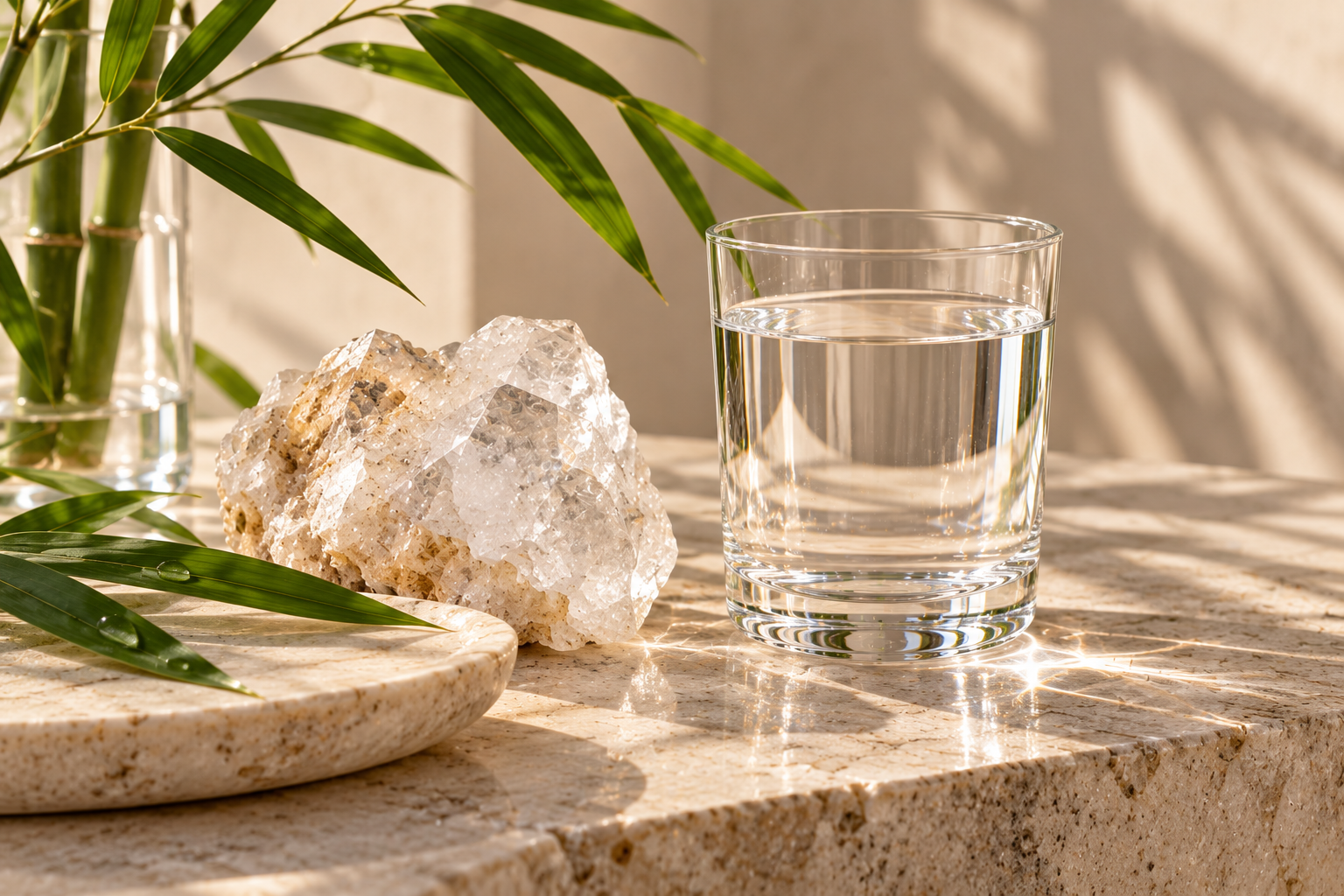
I was reading a supplement label when I realized how little I actually understood about any of these words. Silicon made me think of Silicon Valley. Silica made me think of those tiny packets tucked inside shoe boxes with DO NOT EAT printed across the front. And orthosilicic acid? I honestly had no idea what that was.
The good news: the difference is much simpler than the terminology makes it sound.
Start With Silicon
Silicon is a natural element found in rocks, soil, water and plants. We also consume small amounts through food and beverages, so dietary silicon isn’t nearly as unusual as the name makes it sound.
Where it gets confusing is that silicon rarely exists by itself in nature. It usually bonds with other elements—one of the most common being oxygen. That’s where silica enters the picture.
Think about ordinary table salt. Sodium and chlorine are two separate elements, but when they are chemically bonded together, they become sodium chloride, or salt. You do not eat sodium and chlorine separately and wait for salt to happen. The combination already exists.
Silica works in much the same way. It already occurs throughout nature in rocks, soil and plants. Bamboo is one plant that can accumulate silica, which is why you may see bamboo-derived silica on supplement labels.
And yes, silica gel is also associated with those little packets inside shoe boxes. That familiar packet contains one form of silica. It does not mean every appearance of the word silica refers to the same thing sitting beside your new shoes.
Then OSA Enters the Conversation
OSA stands for orthosilicic acid, but the full name makes it sound far more complicated than it needs to be. The important part is that OSA is a soluble form of silicon.
If soluble is another word science class failed to make memorable, think about stirring sugar into coffee. The sugar seems to disappear, but it has not vanished. It has dissolved into the liquid. OSA is not sugar, of course, but the comparison makes the idea much easier to picture.
So now the difference is easier to see. Silicon is an element. Silica is a silicon-and-oxygen compound found throughout nature. OSA, or orthosilicic acid, is a soluble form of silicon.
Related? Yes. The same thing? No.
So Why Stabilized OSA?
This is where the label gets interesting. OSA does not necessarily remain in the same soluble form under every condition. Stabilization is used to help maintain OSA in a soluble form. That is really all the chemistry most of us need. And once I understood that, I looked at the COLASIL® formula differently.
COLASIL® | Collagen Generator is built around stabilized OSA. It also contains Bambusa vulgaris sprout extract, a plant-derived source of naturally occurring silica.
At first glance, those might look like two ways of saying the same thing. They are not. One is stabilized OSA. The other is a plant-derived source of silica. They are related through silicon, but they play distinct roles in the formula.
Suddenly, the label was considerably easier to understand.
And the silicon conversation is no longer quite so obscure. COLASIL® was included among the products featured in VOGUE’s March 2026 article about silicon supplementation.
Why Does the Form Matter?
Seeing silicon or silica on a supplement label does not tell you the whole story. Different forms and sources are not the same thing.
That does not make one automatically “good” and another “bad.” It means one simple thing: the form matters.
So the next time you see silicon, silica, bamboo-derived silica, OSA or stabilized OSA on a label, you do not need a chemistry textbook.
There is really only one question worth remembering: What form is it?
Because silicon, silica and OSA are related, but they are not interchangeable. Once you understand that distinction, the terminology stops feeling quite so intimidating—and supplement labels become considerably easier to read.
And that may be the science lesson we all should have gotten the first time.
Further Reading
For the research behind silicon and orthosilicic acid:
Jugdaohsingh R. Silicon and bone health. Journal of Nutrition, Health & Aging. 2007;11(2):99–110.
Reffitt DM, Ogston N, Jugdaohsingh R, et al. Orthosilicic acid stimulates collagen type I synthesis and osteoblastic differentiation in human osteoblast-like cells in vitro. Bone. 2003;32(2):127–135.
Petersen Vitello Kalil CL, Campos V, Cignachi S, et al. Evaluation of cutaneous rejuvenation associated with the use of ortho-silicic acid stabilized by hydrolyzed marine collagen. Journal of Cosmetic Dermatology. 2018;17(5):814–820.
These publications are provided for scientific background and are not clinical studies of the finished COLASIL® formula.
Explore the COLASIL® Journal
This article is for educational purposes only and is not intended as medical advice.
These statements have not been evaluated by the Food and Drug Administration. This product is not intended to diagnose, treat, cure, or prevent any disease.